
Top Cybersecurity Threats Everyone Should Know (2026 Research Report)
Evidence from government agencies, global breach investigations, and threat intelligence reports shows that ransomware, phishing, identity attacks, vulnerability exploitation, supply-chain compromises, and AI-powered deception are the most significant cybersecurity threats organizations and individuals face today.
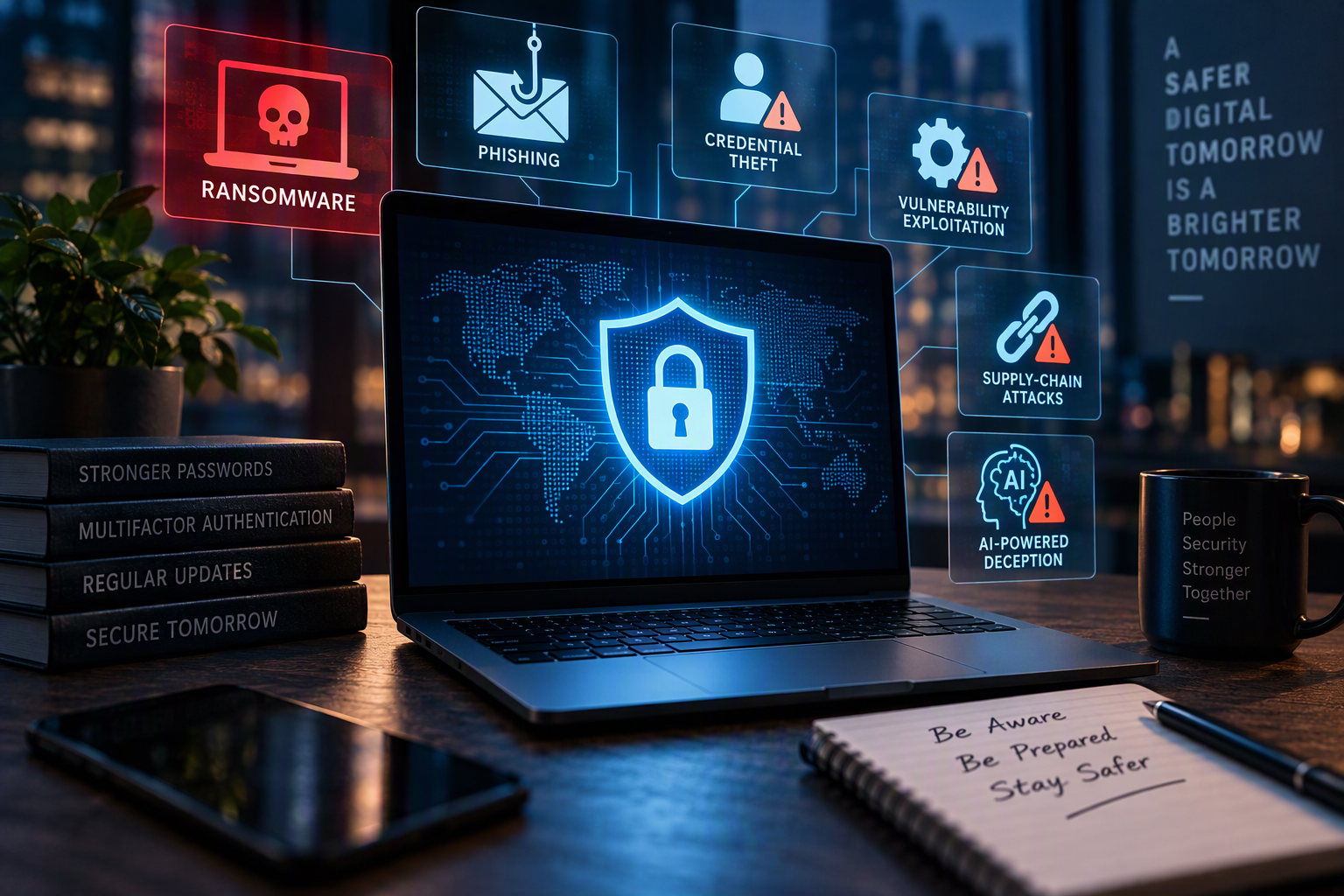
Cybersecurity threats in 2026 are becoming faster, more automated, and increasingly focused on identity rather than traditional malware. Evidence from CISA, ENISA, Verizon's Data Breach Investigations Report, CrowdStrike, and other authoritative sources identifies six dominant risks: ransomware, phishing, credential theft, vulnerability exploitation, supply-chain compromise, and AI-enabled deception. This research-based report examines what is supported by current evidence, where uncertainty remains, and what organizations and consumers should prioritize.
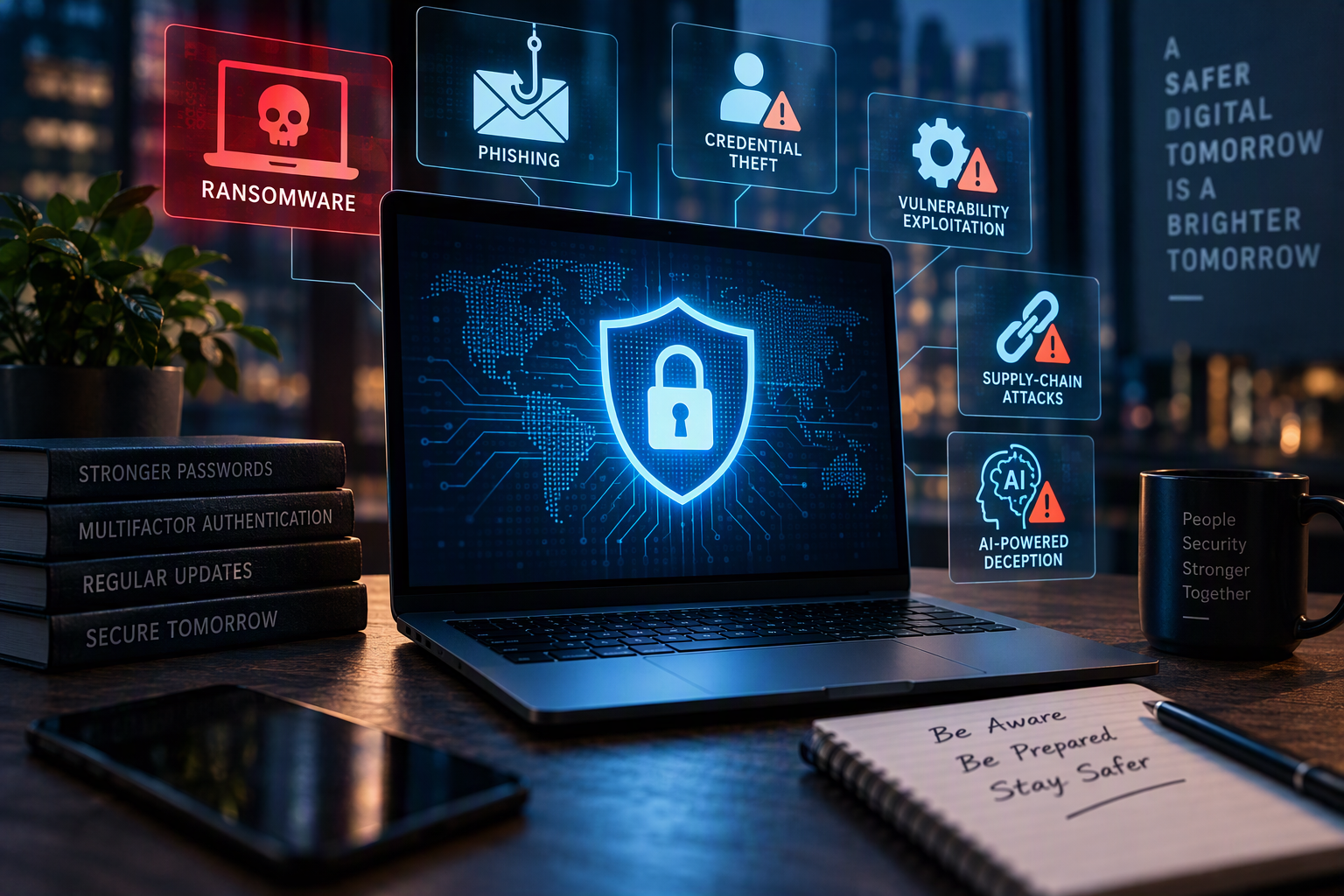
Cybersecurity threats in 2026 are becoming faster, more automated, and increasingly focused on identity rather than traditional malware. Evidence from CISA, ENISA, Verizon's Data Breach Investigations Report, CrowdStrike, and other authoritative sources identifies six dominant risks: ransomware, phishing, credential theft, vulnerability exploitation, supply-chain compromise, and AI-enabled deception. This research-based report examines what is supported by current evidence, where uncertainty remains, and what organizations and consumers should prioritize.
Cybersecurity headlines often focus on the newest technology or the latest breach. Yet the strongest evidence from 2025 and 2026 suggests that the most dangerous threats are not entirely new. Instead, attackers are becoming faster, more automated, and increasingly skilled at exploiting trusted identities and human behavior.
Analysis from the U.S. Cybersecurity and Infrastructure Security Agency (CISA), the European Union Agency for Cybersecurity (ENISA), Verizon's 2025 Data Breach Investigations Report (DBIR), CrowdStrike's 2025 Global Threat Report, and other major threat intelligence sources points consistently toward six threats that deserve the greatest attention.
The pattern is clear: modern attackers increasingly rely on stolen credentials, social engineering, third-party compromises, and automation rather than traditional malware alone.This shift matters because organizations can no longer rely solely on perimeter defenses. Attackers frequently gain access by impersonating legitimate users, abusing valid credentials, exploiting known vulnerabilities, or infiltrating trusted suppliers.
As a result, cybersecurity is increasingly becoming a challenge of trust, authentication, and operational resilience.
The Shift in the Cybersecurity Landscape
A decade ago, cybersecurity discussions often centered on computer viruses and malware infections. While malware remains important, current evidence indicates that many successful attacks now begin with identity compromise, phishing, or trusted access mechanisms.
This shift matters because organizations can no longer rely solely on perimeter defenses. Attackers frequently gain access by impersonating legitimate users, abusing valid credentials, exploiting known vulnerabilities, or infiltrating trusted suppliers.
As a result, cybersecurity is increasingly becoming a challenge of trust, authentication, and operational resilience.
1. Ransomware Remains the Most Disruptive Threat
Among all cyber threats, ransomware continues to rank as one of the most damaging and costly.
Ransomware attacks typically involve encrypting systems, stealing sensitive information, or both. Modern criminal groups increasingly employ "double extortion" tactics, stealing data before encryption and threatening public disclosure if victims refuse to pay.
ENISA identifies ransomware as one of the most significant threats facing organizations, while Verizon's 2025 DBIR found ransomware involvement in 44% of analyzed breaches.
Several factors explain ransomware's continued effectiveness:
- Operational disruptions can last days or weeks.
- Recovery costs can exceed the ransom demand itself.
- Stolen data creates regulatory and reputational consequences.
- Small and medium-sized businesses often lack sufficient defensive resources.
The consistency of findings across CISA, ENISA, Verizon, and multiple independent threat reports makes ransomware one of the most firmly established cybersecurity risks today.
Evidence confidence: High
If ransomware is among the most damaging threats, phishing remains one of the most common ways attackers gain initial access.
Rather than attacking software directly, phishing targets people. Attackers use fraudulent emails, messages, websites, phone calls, and impersonation schemes to trick victims into revealing credentials, installing malware, or approving unauthorized actions.
ENISA reports that phishing remains the dominant intrusion method and accounts for approximately 60% of observed initial-access cases.
The threat is evolving rapidly because generative AI allows criminals to produce:
- More convincing emails
- Improved grammar and language localization
- Large-scale personalization
- Executive impersonation attempts
- Automated spear-phishing campaigns
One notable indicator comes from CrowdStrike, which reported a 442% increase in voice-phishing, or "vishing," activity between the first and second half of 2024.
The success of phishing highlights an enduring reality of cybersecurity: human trust remains a preferred target for adversaries.
Evidence confidence: High
3. Identity-Based Attacks Are Replacing Traditional Malware
One of the most important developments in modern cybersecurity is the rise of identity-focused attacks.
Instead of breaking into systems using malware alone, attackers increasingly log in with stolen credentials.
CrowdStrike reports that 79% of observed intrusions were malware-free, meaning attackers relied on legitimate credentials, authorized tools, and trusted access mechanisms.
Common tactics include:
- Credential theft
- Password reuse attacks
- Session hijacking
- Token theft
- MFA fatigue attacks
- Help-desk impersonation
These attacks create significant defensive challenges because malicious activity often appears similar to normal user behavior.
The growing emphasis on identity theft has elevated the importance of:
- Multifactor authentication
- Passwordless authentication
- Identity governance
- Access monitoring
- Session analytics
Current evidence strongly suggests that credential security is now among the most important components of cyber defense.
Evidence confidence: High
4. Vulnerability Exploitation Is Accelerating
Attackers are exploiting software vulnerabilities faster than many organizations can patch them.
Government agencies and threat intelligence organizations increasingly emphasize the importance of known exploited vulnerabilities, or flaws that are already being actively used by attackers.
ENISA estimates that vulnerability exploitation accounts for roughly one-fifth of initial intrusions.
Meanwhile, CISA's Known Exploited Vulnerabilities initiatives highlight the need for organizations to prioritize patching based on real-world exploitation rather than severity scores alone.
The challenge is growing more complex. According to Forescout's 2026 H1 Threat Review, more than 37,000 vulnerabilities were disclosed during the first half of 2026, representing a 51% year-over-year increase.
This trend raises several concerns:
- Security teams must evaluate a growing volume of vulnerabilities.
- Attackers can weaponize flaws shortly after disclosure.
- Resource-constrained organizations struggle to maintain patching speed.
- Legacy systems remain difficult to update.
The evidence strongly supports vulnerability management as a critical component of modern cybersecurity programs.
Evidence confidence: High
5. Supply-Chain Attacks Are Expanding
Organizations increasingly face risks that originate outside their own networks.
Supply-chain attacks occur when adversaries compromise trusted providers such as:
- Software vendors
- Managed service providers
- Cloud platforms
- Open-source dependencies
- Technology partners
These attacks are particularly difficult because organizations may maintain strong security practices internally yet remain exposed through suppliers.
Verizon's 2025 DBIR found third-party involvement in approximately 30% of breaches, roughly double the previous year's level.
The increasing complexity of business ecosystems compounds the challenge. Large organizations often depend on hundreds or thousands of vendors, each introducing potential risk.
As a result, vendor assessment, third-party monitoring, software provenance verification, and supply-chain governance are becoming core cybersecurity priorities.
Evidence confidence: High
6. AI-Powered Deception Is Emerging as a Force Multiplier
Artificial intelligence represents an important new development in cybercrime, but current evidence suggests its primary role is amplification rather than replacement.
Threat intelligence reports and government advisories indicate growing use of AI in:
- Phishing campaigns
- Social engineering
- Reconnaissance
- Content generation
- Voice cloning
- Deepfake creation
- Executive impersonation
Recent FBI and CISA advisories have specifically warned about AI-enhanced phishing, smishing, and impersonation schemes.
However, the evidence also supports a more nuanced conclusion.
While AI-assisted cybercrime is clearly increasing, evidence remains weaker for fully autonomous AI systems conducting sophisticated end-to-end compromises without human oversight.
This distinction matters because public discussions sometimes overstate current capabilities.
The strongest evidence today supports the conclusion that AI is making existing criminal techniques more efficient, not fundamentally replacing human attackers.
Evidence confidence: Moderate to High
Where Evidence Is Strongest and Where Caution Is Needed
Several conclusions are consistently supported across independent government agencies, breach investigations, and threat intelligence reports:
- Ransomware remains highly disruptive.
- Phishing continues to dominate initial access.
- Credential theft is increasingly replacing malware-based intrusion methods.
- Supply-chain risks are growing.
- AI is amplifying social engineering campaigns.
At the same time, important uncertainties remain.
Researchers continue monitoring:
- Whether AI agents will significantly automate sophisticated attacks.
- Attacks targeting AI systems themselves.
- Long-term implications of AI-assisted vulnerability discovery.
- Nation-state adoption of advanced AI-enabled cyber operations.
These remain active areas of study rather than settled conclusions.
Conclusion
The most important cybersecurity threats of 2026 are not entirely new. What has changed is the speed, scale, and efficiency with which attackers exploit them.
Current evidence shows that organizations and individuals should prioritize six areas above all others:
- Ransomware
- Phishing and social engineering
- Identity and credential theft
- Exploitation of unpatched vulnerabilities
- Supply-chain attacks
- AI-enabled impersonation and deception
Organizations that implement multifactor authentication, accelerate patch management, adopt phishing-resistant authentication methods, monitor third-party risk, and train users to recognize AI-assisted scams are likely to be better positioned against today's most significant cyber threats.
The central lesson from current research is straightforward: attackers are increasingly targeting trust, identities, and relationships. Defending those assets may be the defining cybersecurity challenge of the next decade.
Key Takeaways
- Ransomware remains among the most damaging forms of cybercrime.
- Phishing continues to be the dominant initial attack vector.
- Identity-based attacks are increasingly replacing malware-driven intrusions.
- Vulnerability exploitation is accelerating as disclosed flaws increase.
- Supply-chain attacks are becoming a major source of organizational risk.
- AI primarily acts as a force multiplier for existing attack techniques.
- Evidence for fully autonomous AI-driven attacks remains limited.
- Multifactor authentication, rapid patching, and vendor-risk management remain among the most effective defensive measures.