
Smart Home Upgrades Ranked by Evidence: Thermostats Lead, Doorbells Lag
Reported savings, loss-prevention claims and crime-deterrence research differ sharply from one connected device to the next.
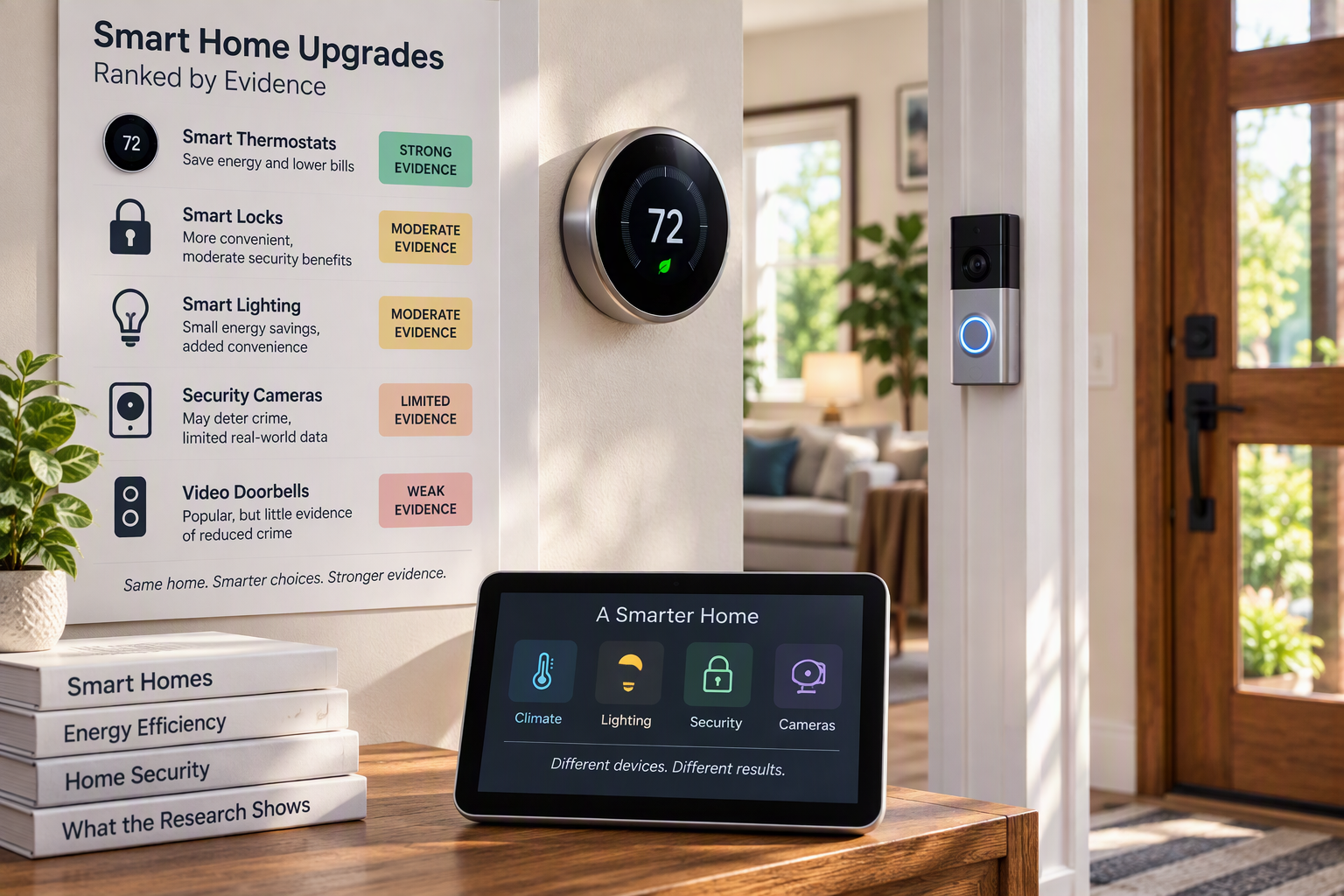
Smart thermostats have the best-documented payback, at roughly $50 a year on average by ENERGY STAR's figure. Whole-home leak shutoffs have a plausible but unproven case, and video doorbells have little proof that they deter crime. Privacy and compatibility belong in the math too.
Of the connected devices households most often consider, the smart thermostat has the strongest record of paying for itself. ENERGY STAR's stated average is about 8% of heating and cooling bills, or roughly $50 a year, which puts payback at about 1.5 to 3 years for typical models. Whole-home water shutoff valves are a plausible but unproven bet, and video doorbells have not been shown to deter crime.
"Smart home" is not one product category, and the quality of evidence varies widely from device to device. Headline percentages often come from manufacturers' own studies, measured against a flattering baseline. A fair ranking of upgrades has to separate what independent field data show from what marketing materials claim.
This article covers four areas: smart thermostats, water-leak detection, video doorbells and cameras, and the Matter compatibility standard along with privacy risks. It leaves out several others, including smart lighting, locks, smoke alarms, resale value and tax credits. Most of the figures below were relayed by secondary pages rather than read at the original source, and the text says so where it matters.
Smart thermostats: the best-documented purchase
What the official figure says
Summaries of the ENERGY STAR smart-thermostat FAQ put the program's average savings at about 8% of heating and cooling bills, or roughly $50 a year. Another summary says the program puts the figure at up to $100 a year for homes with high heating and cooling bills. The FAQ itself was not retrieved for this article, so these numbers are best read as reported ENERGY STAR figures, not verified quotations.
The stakes are set by what heating and cooling cost. According to secondary pages summarizing ENERGY STAR's product page, almost half of the average household's annual energy bill goes to heating and cooling, at more than $900 a year. A device that trims a modest percentage of that spending can matter, but only a modest percentage of it.
Certification is where the 8% figure gets its footing. Consumer and trade pages describe a rule requiring manufacturers to submit a year of anonymized data from hundreds of real homes across US climate zones. Those homes must show average runtime cuts of at least 8% for heating and 10% for cooling. One source adds a floor at the 20th percentile of homes, 4% for heating and 5% for cooling. That detail should be confirmed against ENERGY STAR's specification before anyone relies on it.
Why manufacturer numbers run higher
Nest published a 2015 study reporting average savings of 10–12% on heating and 15% on cooling. It drew on 735 homes with gas furnaces and 624 with central air conditioning, and Nest estimated about $140 a year for the average customer. Some sites describe the work as two independent studies, but who funded and ran them could not be confirmed, so the independence claim should not be repeated.
ecobee claimed savings of up to 23% based on an internal 2013 analysis. A secondary site says the larger utility-partnered study included room sensors, which add savings beyond what the thermostat alone delivers. That description is weakly sourced and needs verification.
The gap between 8% and 23% mostly reflects the choice of baseline. A Southern California HVAC-services page argues that manufacturer studies typically compare against a thermostat left at 72°F all day. Most households do not run their systems that way, so the real gain over actual behavior is smaller. That page is analysis, not a study, but its logic matches the pattern in the numbers.
| Source | Heating | Cooling | Combined or dollars | Caveat |
|---|---|---|---|---|
| ENERGY STAR average | about 8% | not stated | about 8% of bills, roughly $50 a year | Average across certified models |
| ENERGY STAR certification floor | at least 8% | at least 10% | not stated | Minimum runtime cut to qualify |
| Nest, 2015 (735 gas-heat homes, 624 central-AC homes) | 10–12% | 15% | about $131–145 a year | Manufacturer-published; baseline and funding unconfirmed |
| ecobee, 2013 internal analysis | not stated | not stated | up to 23% | Manufacturer claim; a later study included room sensors |
| ACEEE/Cadmus, two Indiana utilities | 12.5–16.1% (gas) | not stated | not stated | Compared with about 5% for the programmable thermostats replaced |
| NREL simulation | not stated | not stated | 0–12% depending on algorithm | Simulation, not field data |
Versus the programmable thermostat
Summaries of an ACEEE/Cadmus study report that smart thermostats saved 12.5–16.1% across two Indiana utilities. Another summary puts savings for the older programmable thermostats they replaced at about 5%. The study was not retrieved, so these figures are secondhand, but they suggest the improvement over a programmable model is real if modest.
A cautionary note comes from the older technology. A Wikipedia entry quotes the EPA as saying available studies indicate no savings from installing programmable thermostats. The stated mechanism is that usability difficulties appear to erode savings over time. Whether the same erosion affects smart thermostats is not established by the sources reviewed, though the logic that unused or confusing features save nothing probably carries over.
The device is, in effect, an automated version of a habit. The DOE Energy Saver page, as quoted by secondary sources, says a household can save as much as 10% a year by turning the thermostat back 7–10°F for 8 hours a day. A household that already does this consistently has less to gain.
Why savings are hard to see on a bill
An HVAC-contractor page quoting an NREL protocol makes a scale point. A 10% cooling saving equals only about a 2% cut in whole-home electricity use, because cooling is about 20% of annual electricity use. The page's own gloss is that this makes savings hard to detect on a bill and easy to overstate in marketing. It also cites NREL simulations that range from 0% to 12% depending on the algorithm, a reminder that results vary with how a device is programmed. The NREL document itself was not read for this article.
Payback arithmetic
At $50 a year, a $75 model takes about a year and a half to pay back, and a $130 model about two and a half years, ignoring installation and rebates. One source says most smart thermostats cost $120–$250 and that many utilities offer $50–$100 rebates. Rebate amounts vary by utility and were not verified. Homes with high bills, extreme climates or no one home by day may do better than the average.
Leak detection and shutoff valves: a plausible case with thin proof
The argument for leak protection rests on a rare but costly event. A Nationwide agent blog, relaying Insurance Information Institute calculations from Verisk/ISO data for 2017–2021, says water damage accounts for 23% of insurance claims, the second-highest source. The same post says about 1 in 60 insured homes has a water-damage or freezing claim each year. The III's own page was not retrieved.
Other pages give different shares for water damage, including 27.6% for 2022 and about 28.6% with no year given. These differ by year and definition and have not been reconciled. Pages that quote average payouts, with figures ranging from over $11,000 to $15,400, come from low-quality sources and need confirmation from III or Verisk data before they are treated as reliable.
What the effectiveness claim rests on
The only quantified effectiveness figure comes from a vendor. In a 2024 press release, Moen said its Flo device can reduce water-damage claim frequency by as much as 96%. An insurer's page repeats the "up to 96%" figure, so the two do not count as independent confirmation. The study behind the number was not found.
Insurance discounts and costs
Discounts depend on the device type. Moen works with Farmers Insurance to supply devices to policyholders, and a tiered discount of 5%, 10% or 15% is described by type: alert-only, automatic main shutoff, or flow-monitoring shutoff. Other pages say point-of-use sensors rarely earn a discount, while whole-home flow monitors with automatic shutoff earn 5–15% with most carriers. Availability varies by insurer and state.
The price gap is wide. A professionally installed whole-home monitor with automatic shutoff runs $1,500 to $3,500, according to the sources reviewed. Alert-only sensors are cheap but less often discounted. Whether a typical household breaks even is unresolved without independent loss-reduction studies, because a 5–15% premium discount alone would take many years to repay that range.
One compilation of unclear origin says only 5% of US single-family homeowners own a smart leak detector. One page argues that appliances and supply lines are usually the landlord's responsibility, which would make whole-home shutoff mainly an owner's purchase. That argument is opinion, not research.
Video doorbells: strong on footage, weak on deterrence
Reporting by Undark and Scientific American in 2023 found very little published data on whether Ring and similar doorbells prevent crime. The researchers quoted include Stickle and Calacci. Calacci, of the MIT Media Lab, said "there's no strong evidence."
The MIT Media Lab paper, published in the peer-reviewed Proceedings of the ACM on Human-Computer Interaction, analyzed about 850,000 posts by about 650,000 users from October 2016 to February 2020. According to the Undark report, it found no strong evidence that doorbells decrease property crime across Los Angeles. The paper itself was not retrieved for this article.
Company claims and their critics
Ring said its doorbells cut burglaries by 50% in two Newark neighborhoods from April to July 2018. MIT Technology Review reported in 2018 that the only study done independently of Ring found neighborhoods without Ring doorbells were less likely to suffer break-ins than those with them. A criminologist told the magazine the evidence was insufficient to prove any reduction in burglaries. That coverage is from 2018 and has not been re-checked against newer work.
What camera research does support
A BGR summary attributes a 40-year systematic review, described as a 2019 City University of New York study, to a different finding. Actively monitored camera systems were associated with significant crime reductions, while passive systems were not. The review covered mostly public-space CCTV rather than home doorbells, so it applies only by analogy. A doorbell that records, but is not watched live, resembles the passive kind.
Absence of evidence is not evidence of no effect. The research is thin, and the main reports date from 2018 to 2023. Summaries also note that doorbell footage can help solve cases even where prevention is unproven. Package and visitor awareness may justify the purchase for some households, but none of the sources reviewed quantifies those benefits.
Matter and privacy: costs that change the math
Compatibility is improving but not guaranteed
Matter is a standard from the Connectivity Standards Alliance meant to let devices from different makers work across Apple Home, Google Home, Amazon Alexa and Samsung SmartThings. Google's developer documentation says a Matter-certified device will work with any Matter-enabled app or ecosystem. That is a vendor's description of the design goal, not a test of real-world results.
Reality is messier, according to the retrieved coverage. Some high-profile brands have not fully supported the standard, so not every device will work with it. Matter over Thread also needs a Thread Border Router in addition to a Matter hub. Sources conflicted on the current Matter version and on certified-product counts, and none came from the alliance itself, so those numbers are left out here. Confidence in any claim about Matter's maturity is low.
Privacy and security as a cost
Consumer Reports' data-privacy expert, in a segment reprinted by TV stations in September and October 2026, said a lot of information leaves the home from the device itself. That information may include location, contact details or video. The segment also recalled that in 2024 CR found a smart-doorbell vulnerability that left the video feed exposed to hackers over the internet. The original CR reports were not retrieved; the account comes from the reprints.
The advice offered is practical: install firmware updates and keep smart appliances on a separate Wi-Fi network. No data in the sources show how common exposed-feed failures are, so the risk cannot be sized, only acknowledged. A Reviews.org survey says 45% of respondents felt devices were listening or watching without their knowledge, but the methodology was not seen and the publisher is a commercial review site.
What the ranking suggests
Ranked by evidence, the smart thermostat comes first. Its average saving is modest, and the manufacturer figures that run two to three times higher depend on baselines that few households match. A payback of about 1.5 to 3 years at ENERGY STAR's average is a reasonable planning figure, with moderate confidence because it rests on one official source that was relayed, not read.
Leak shutoff valves follow, with a logical case but vendor-sourced proof. Video doorbells come last on the question of crime prevention, though they may earn their keep as convenience tools. The gaps in this review are large enough that verified primary data, especially on rebates, insurer discounts and independent loss-reduction studies, would change the picture. Those are the numbers worth watching.
Frequently asked questions
How much does a smart thermostat save?
According to summaries of ENERGY STAR's FAQ, the program's average is about 8% of heating and cooling bills, or roughly $50 a year. Manufacturer studies report higher figures, such as Nest's 10–12% on heating and 15% on cooling, but they typically use a baseline of a thermostat left at 72°F all day. Savings are smaller for households that already set back their temperature consistently.
How long does a smart thermostat take to pay for itself?
At $50 a year, a $75 model pays back in about a year and a half and a $130 model in about two and a half years, ignoring installation and rebates. One source says most smart thermostats cost $120–$250, and many utilities offer $50–$100 rebates, though amounts vary by utility and were not verified.
Does a smart water leak detector lower home insurance costs?
It depends on the device and the insurer. Pages reviewed say point-of-use sensors rarely earn a discount, while whole-home flow monitors with automatic shutoff earn 5–15% with most carriers. Those monitors cost $1,500 to $3,500 installed, and availability varies by insurer and state.
Do video doorbells deter crime?
Not demonstrably. Undark and Scientific American reported in 2023 that very little published data exists, and an MIT Media Lab paper found no strong evidence of reduced property crime across Los Angeles. Doorbells may still help with package and visitor awareness and with footage, which the research did not quantify.
Does Matter make all smart home devices work together?
Not fully. Matter is designed so certified devices work across major ecosystems, but some high-profile brands have not fully supported it. Matter over Thread also needs a Thread Border Router in addition to a Matter hub.
Sources
- Smart Thermostat Energy Savings: What the Data Actually Shows , HVAC Zone NJ
- Smart Thermostat Savings 2026: Real Data & ROI Analysis , Joule IO
- Do Smart Thermostats Save Money? What the Data Shows , Smart Home Matrix
- Smart Thermostat Savings: What ENERGY STAR Says , Jolt Journal
- Programmable thermostat , Wikipedia
- Help Homeowners Save More with Water Detection Technology , Nationwide Agency Forward blog
- Smart Home Water Leak Detection: How It Prevents Water Damage and Saves on Home Insurance , Tower Hill Insurance
- Smart Leak Detection From Moen (press release) , Business Wire (2024-06-13)
- Water Leak Detection and Property Insurance Statistics (2026) , RapidEye (2026-07-25)
- Whole House Water Leak Detector: Sensor vs. Auto-Shutoff , Northern Ben Franklin
- Do Video Doorbells Really Help to Deter Crime? , Undark (2023-12-04)
- Do Video Doorbells Really Prevent Crime? , Scientific American (2023-12-04)
- Video doorbell firm Ring says its devices slash crime—but the evidence looks flimsy , MIT Technology Review (2018-10-19)
- Studies Show Video Doorbells Might Not Be As Effective As You Think - Here's Why , BGR
- Consumer Reports: Is your smart home spying on you? , KYMA (Consumer Reports segment) (2026-10-20)
- Is your smart home spying on you? , WRAL (Consumer Reports segment) (2026-09-15)
- State of Consumer Data 2026: Americans Want More Control Over What Their Devices Collect , Reviews.org
- What is Matter? | Google Home Developers , Google
- What Matter and Thread actually mean for your smart home in 2026 , MakeUseOf
This article was drafted with the help of AI and reviewed by Jaroha editors before publication.