
Intermittent Fasting Works About as Well as Cutting Calories, Reviews Find
Large reviews show modest weight loss, no clear edge over ordinary dieting, and a heart-risk scare that rests on an unreplicated abstract.
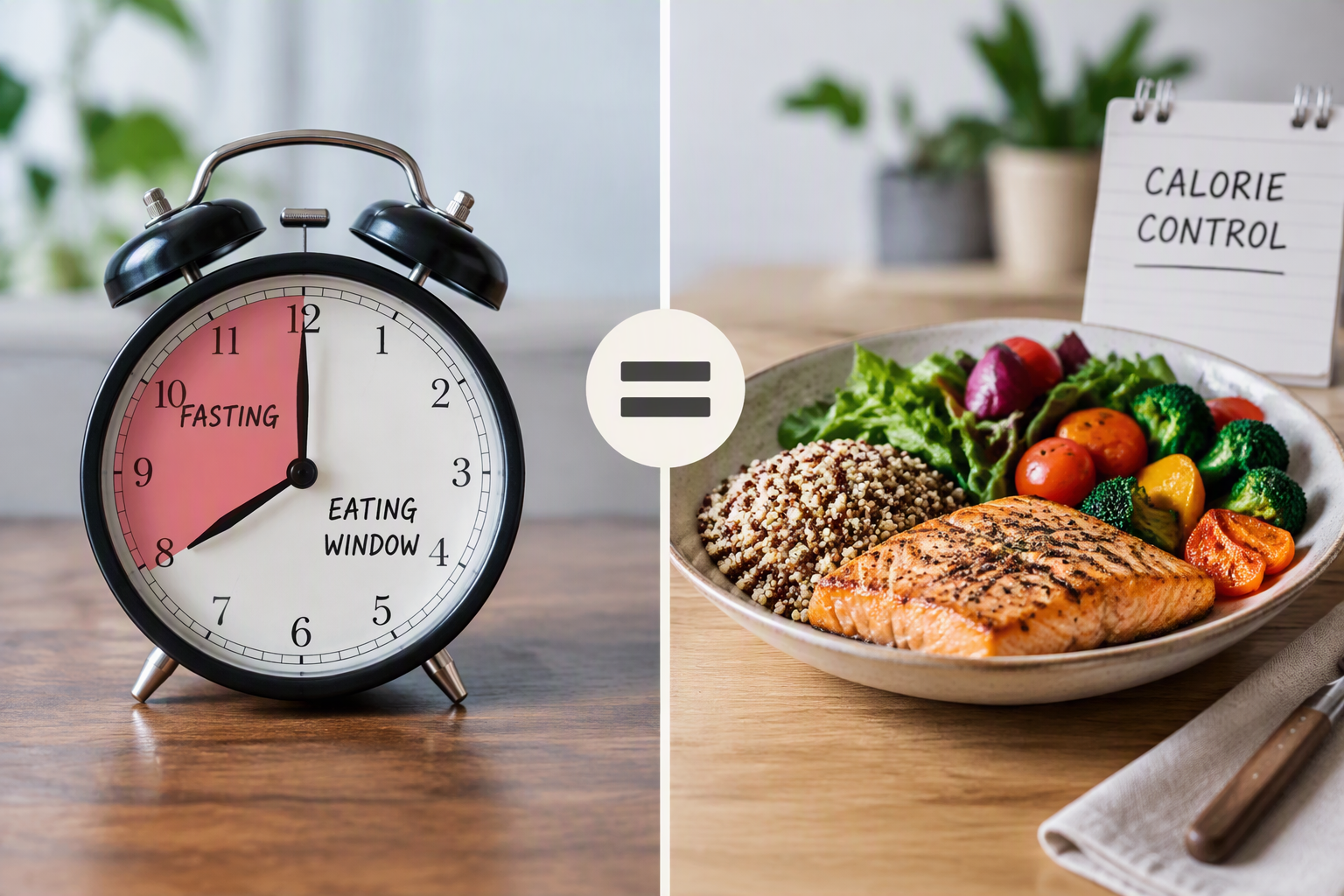
Two large reviews and a landmark trial find intermittent fasting produces modest weight loss, in the same range as ordinary calorie cutting. The widely shared claim that an 8-hour eating window raises heart-death risk by 91% comes from a preliminary abstract that has not been confirmed. Long-term benefits and safety remain unproven.
Intermittent fasting produces weight loss, but the best available evidence suggests it performs about the same as ordinary calorie cutting, not better. A 2026 Cochrane review of 22 randomized trials and a 2025 BMJ analysis of 99 trials point in that direction, as does a well-known 2022 trial in the New England Journal of Medicine. Intermittent fasting is not magic, and for most healthy adults the evidence does not show it to be harmful.
The question matters because intermittent fasting has become one of the most popular ways to try to lose weight, and it now carries two competing reputations. One says it works where other diets fail. The other, fueled by a 2024 headline about a 91% higher risk of cardiovascular death, says it may damage the heart. Neither story holds up well against the research.
What intermittent fasting actually means
The phrase covers a family of regimens, and the studies discussed below do not all test the same one. The sources used here define the main types this way.
- Time-restricted eating (TRE): limiting eating to a set number of hours each day, with windows that may range from 4 to 12 hours.
- 16:8: fasting for 16 hours and eating in the remaining eight.
- Alternate-day fasting (ADF): alternating between days of eating very few calories and days of eating what one wants.
- Whole-day fasting: includes 5:2 patterns, with regular eating for 5 days and energy restriction for 2 days per week.
- Continuous energy restriction (CER): ordinary daily calorie cutting, the standard comparison in most trials.
This distinction explains why headlines about intermittent fasting often seem to contradict one another. A finding about an 8-hour eating window says little about 5:2 fasting, and a result in adults with obesity may not transfer to lean or older adults. The trials also come from several countries, including China, Germany and Spain.
The weight-loss evidence: modest and not clearly better
The 2026 Cochrane review
In February 2026, Garegnani and colleagues published a systematic review in the Cochrane Database of Systematic Reviews. It included 22 randomized controlled trials with 1,995 participants who had overweight or obesity, and it examined alternate-day fasting, periodic fasting and time-restricted feeding. Cochrane's summary said intermittent fasting did not appear to have a clinically meaningful effect on weight loss compared with standard dietary advice or doing nothing.
Intermittent fasting just doesn’t seem to work for overweight or obese adults trying to lose weight.
Other experts read the same data more narrowly. Francisco Tinahones, quoted by Science Media Centre Spain, said the review does not claim intermittent fasting is ineffective for weight loss. What it says, in his reading, is that there is no evidence it is superior to classic calorie restriction. That is a different statement from the blunter press-release quote, and the gap between the two is worth keeping in view.
The raw numbers show how much overlap there was between groups. According to commentary in The Conversation, weight change ranged from a 10% loss to a 1% gain, whether people followed intermittent fasting or received dietary advice. Only six studies were in the comparison of intermittent fasting against no intervention, and quality-of-life findings rested on just three studies. Few trials had looked at long-term results.
Reports also differ on how sure Cochrane was. News-Medical's summary described the review as based largely on low- to very-low-certainty evidence with potential risk of bias, while Medical News Today reported moderate certainty that intermittent fasting has little to no effect on weight loss. The two may refer to different comparisons, which cannot be resolved without the full text of the review.
The 2025 BMJ network meta-analysis
A June 2025 analysis in the BMJ by Semnani-Azad and colleagues pooled 99 randomized trials that compared intermittent fasting diets with continuous energy restriction or unrestricted eating. Against an unrestricted diet, both intermittent fasting strategies and calorie-restricted diets reduced body weight. The BMJ Group summary described intermittent fasting as comparable to traditional diets.
Alternate-day fasting was the only strategy to show a small benefit over continuous calorie restriction, with a mean difference of −1.29 kg. A linked editorial noted that this was a small effect with moderate GRADE certainty and did not reach the prespecified clinical-relevance threshold of at least 2 kg. Alternate-day fasting also showed small reductions against time-restricted eating (−1.69 kg) and whole-day fasting (−1.05 kg).
The authors listed their own limits: high heterogeneity, small sample sizes in many trials, and low to moderate certainty for most outcomes. Naveed Sattar, commenting for Science Media Centre Spain, said nothing is magical about intermittent fasting beyond being another way to keep total calorie intake lower. The Cochrane and BMJ reviews also overlap in the trials they include, so they are not fully independent confirmations of each other.
| Source (year, design) | Population | Comparison | Result | Certainty or caveat |
|---|---|---|---|---|
| Cochrane (2026), 22 RCTs, n=1,995 | Adults with overweight or obesity | IF vs dietary advice; IF vs no intervention | No clinically meaningful difference | Low to moderate certainty (reports differ); few long-term trials |
| BMJ network meta-analysis (2025), 99 RCTs | Adults, mixed | ADF vs CER | −1.29 kg (ADF better) | Moderate GRADE; below 2 kg threshold |
| BMJ network meta-analysis (2025) | Same | ADF vs TRE | −1.69 kg | Small effect |
| BMJ network meta-analysis (2025) | Same | ADF vs whole-day fasting | −1.05 kg | Small effect |
| Liu, NEJM (2022), RCT, n=139 | Adults with obesity, China | 8-hour TRE plus calorie restriction vs calorie restriction alone, 12 months | −8.0 kg vs −6.3 kg; difference −1.8 kg (95% CI −4.0 to 0.4; P=.11) | Underpowered; baseline eating window already short |
The 2022 NEJM trial
One of the most cited single trials, published in the New England Journal of Medicine in April 2022 by Liu and colleagues, randomized 139 patients with obesity in China. One group ate only between 8:00 a.m. and 4:00 p.m. while restricting calories, and the other restricted calories alone. At 12 months, mean weight loss was 8.0 kg in the time-restricted group and 6.3 kg in the calorie-restriction group, and 118 participants (84.9%) completed the year.
The net difference of −1.8 kg had a 95% confidence interval of −4.0 to 0.4 (P=.11), so the trial reported no greater weight loss from the 8-hour regimen, and both groups reached similar caloric deficits. The authors speculated that the data support the importance of caloric restriction when people follow time-restricted eating. Reviewers noted limits: a small sample, and a baseline eating period shorter than reported elsewhere, so moving to 8:00 a.m.–4:00 p.m. may not have been a large change.
A published critique argues that the confidence interval is not consistent with concluding time-restricted eating was not beneficial. On that reading the trial was underpowered rather than proof of equivalence. This is a single commentary, but the statistical point is a reminder that a non-significant result is not the same as no effect.
The 91% heart-death headline
In March 2024, the American Heart Association issued a press release saying that over 20,000 adults who ate within an 8-hour window had a 91% higher risk of cardiovascular death. The reference group ate across 12 to 16 hours. The claim spread widely, but it came from a preliminary abstract (P192) presented at the AHA's EPI|Lifestyle sessions, not from a full peer-reviewed paper.
The study was observational. Deaths were followed through December 2019 using the National Death Index, and a McGill summary says participants had completed two separate 24-hour food questionnaires in a national survey. The same abstract found that time-restricted eating did not reduce overall risk of death from any cause. Among people with existing cardiovascular disease, an eating window of 8 to under 10 hours carried a hazard ratio of 1.64 (95% CI 1.02–2.63), though a press summary rounded this to 66% in a way the available sources do not reconcile.
The authors' own caveat was that the study identified an association, which does not mean time-restricted eating caused cardiovascular death. The abstract concluded the findings require replication. In a collective response dated March 21, 2024, 34 researchers who study time-restricted eating and fasting raised methodological objections.
- Two days of dietary data from a single time point were used to characterize habitual eating.
- Time-restricted eating was defined by eating duration alone, and the window's timing relative to sleep was not accounted for.
- There were few cause-specific deaths.
- Reverse causality is a concern, since poor health can itself change eating patterns.
Some of the signatories run intermittent fasting trials and so have an interest in the topic, though the methodological points stand on their own. Kenneth Mukamal, quoted by the AHA, said it is too soon to conclude that people should avoid time-restricted eating if it helps them meet weight-loss goals. The research behind this article found no peer-reviewed full publication or replication of the signal, though it could not confirm that none exists.
Metabolic markers: the fasting window or the calories?
Some research finds that time-restricted eating improves blood pressure, blood glucose and cholesterol, according to commentary from the Texas Heart Institute, which also notes those studies were short-term. A small German crossover study reported in January 2026 complicates that picture. In it, 31 women with overweight or obesity followed two fasting schedules for two weeks each, and they lost some weight, but lower blood sugar, blood pressure and cholesterol did not show up.
The authors suggested that benefits seen in other studies may come from calorie restriction that accompanies time-restricted eating rather than from the shorter eating window itself. This is a small, short trial, and the journal could not be identified in the research. It supports a hypothesis often summarized as calories, not the clock, but it cannot settle it. The NEJM trial and expert commentary lean the same way, and the case remains unproven.
Keeping weight off
A University of Granada study in Clinical Nutrition (2026;63:106706) followed 99 adults with overweight or obesity through a 12-week program, and weight-loss benefits were still visible a year later. According to ScienceDaily, both early-window and late-window groups kept significantly greater weight loss at 12 months. Both news items trace to one university press release, so the findings need checking against the paper, particularly the control group and whether the benefit is measured against baseline or a comparison group.
The result is not inconsistent with Cochrane, which found few long-term trials. Commentary linked to the Cochrane review in The Conversation says it is possible intermittent fasting could be a long-term tool for weight maintenance, which is a possibility rather than a finding. A separate single-site 2026 study reported weight loss, lower blood pressure and glucose, and gut-bacteria shifts in adults with obesity. It cannot show whether gut bacteria drive brain changes, the reverse, or a third factor is responsible, so it is best treated as a source of hypotheses.
Who should be cautious
A University of Illinois Chicago summary of a review by intermittent fasting researchers says none of the studies showed fasting caused an eating disorder. All of them, however, screened out people with a history of eating disorders. The absence of evidence of harm is therefore partly an artifact of who was excluded. The researchers say people with such a history should not try intermittent fasting, and they urge caution with adolescents who have obesity. This is a narrative summary written by proponents of the approach.
Johns Hopkins guidance, relayed through a secondary site, flags children and teens under 18, pregnant or breastfeeding people, people with type 1 diabetes, and anyone with a history of eating disorders. That is guidance rather than trial evidence, and the original page could not be retrieved. Healthline reports anecdotal accounts of periods stopping, which conflicts with the UIC review's claim that sex hormones are unaffected, and the evidence on both sides is weak. Hunger is the most commonly cited side effect, with headache, fatigue and dizziness also mentioned by secondary sources of low evidentiary weight.
This is researched context, not personal advice. Anyone with diabetes, a history of disordered eating or another medical condition would normally discuss any major change in eating with a clinician.
What it means, and what to watch
The most defensible reading is modest. Intermittent fasting can help people lose weight, mostly it seems by helping them eat less, and it has not been shown to beat other ways of eating less. For people who find counting calories hard, a simple clock-based rule may be easier to follow, though that benefit is a reasonable idea rather than a demonstrated one. For the 91% claim, the right posture is patience, since neither the scare nor the all-clear is established.
The next test is whether longer, better-designed trials confirm what the shorter ones suggest. Until then, the useful question is less whether intermittent fasting works than whether a given pattern is one a person can sustain safely.
Frequently asked questions
Does intermittent fasting work for weight loss?
It produces weight loss, but reviews find it is not clearly better than ordinary calorie cutting. A 2026 Cochrane review of 22 trials found no clinically meaningful difference against standard dietary advice or doing nothing, though experts disagree on how to read the comparison with doing nothing. A 2025 BMJ analysis of 99 trials found intermittent fasting comparable to traditional diets.
Is alternate-day fasting better than other types?
The BMJ analysis found alternate-day fasting had a small edge over continuous calorie restriction, at −1.29 kg. The editorial linked to the analysis noted this was below the prespecified clinical-relevance threshold of at least 2 kg.
Does eating within 8 hours raise the risk of dying from heart disease?
A preliminary 2024 abstract reported a 91% higher risk of cardiovascular death in people eating within 8 hours a day. It was observational, so it shows an association, not a cause, and its authors said replication is needed. Thirty-four fasting researchers criticized its methods, and no replication was found.
Is intermittent fasting safe for everyone?
No. Trials screened out people with a history of eating disorders, so safety data for them are absent. Guidance cited in the research flags children and teens under 18, pregnant or breastfeeding people, people with type 1 diabetes, and anyone with an eating-disorder history. This is context rather than personal medical advice.
Are the benefits of intermittent fasting long-lasting?
That is unproven. Cochrane noted that few trials examined long-term results. A 2026 University of Granada study of 99 adults reported weight-loss benefits still visible a year later, but it is a single study known mostly through a press release.
Sources
- Evidence behind intermittent fasting for weight loss fails to match hype , Cochrane
- Intermittent fasting fails to beat standard dieting for weight loss , ScienceDaily
- Intermittent fasting doesn’t have an edge for weight loss, but might still work for some , The Conversation
- Does intermittent fasting help you lose more weight? Evidence review finds no clear advantage , News-Medical (2026-02-17)
- Intermittent fasting for weight loss: Is it actually effective? , Medical News Today
- Intermittent Fasting Offers No Clear Advantage , Medscape
- Intermittent fasting is not as effective for weight loss in obese or overweight individuals, according to a meta-analysis , Science Media Centre Spain
- Intermittent fasting comparable to traditional diets for weight loss , BMJ Group
- Intermittent fasting as a nutritional tool , BMJ (via PubMed Central) (2025-06-18)
- Intermittent fasting comparable to traditional diets for weight loss , EurekAlert
- Intermittent fasting weight loss comparable to that of calorie restriction diets , Science Media Centre Spain
- Calorie Restriction with or without Time-Restricted Eating in Weight Loss , New England Journal of Medicine (2022-04-20)
- Time-restricted eating on weight loss: implications from the TREATY study , PubMed Central
- Evaluating evidence regarding the efficacy of time-restricted eating for weight loss , PubMed Central
- Calorie Restriction with or without Time-Restricted Eating in Weight Loss , The Endocrinologist, Society for Endocrinology
- 8-hour time-restricted eating linked to a 91% higher risk of cardiovascular death , American Heart Association (2024-03-18)
- Abstract P192: Association Between Time-Restricted Eating and All-Cause and Cause-Specific Mortality , Circulation, American Heart Association (2024-03-19)
- Time-restricted eating may raise cardiovascular death risk in the long term , American Heart Association News (2024-03-18)
- Intermittent Fasting and the Perils of Fast Facts , McGill Office for Science and Society
- Collective Reponse to AHA press release on TRE , University of Illinois Chicago (2024-03-21)
- Time Restricted Eating Research Unveiled at AHA Scientific Sessions Raises Concerns , Texas Heart Institute
- Study Raises Serious Questions About The Benefits of Intermittent Fasting , ScienceAlert (2026-01-06)
- Intermittent fasting triggers surprising changes in the brain , ScienceDaily (2026-05-31)
- Intermittent fasting helped people keep weight off for a year , ScienceDaily
- Intermittent fasting maintains long-term weight loss, regardless of meal timing, study shows , Medical Xpress
- Myths about intermittent fasting, debunked , University of Illinois Chicago
- Intermittent Fasting: How To, Types, Benefits, and Safety , Healthline
This article was drafted with the help of AI and reviewed by Jaroha editors before publication.