
How NIL Deals Work for College Athletes
From endorsements and social media sponsorships to revenue sharing under the House settlement, college athletes operate in a dramatically different financial landscape than they did just a few years ago.
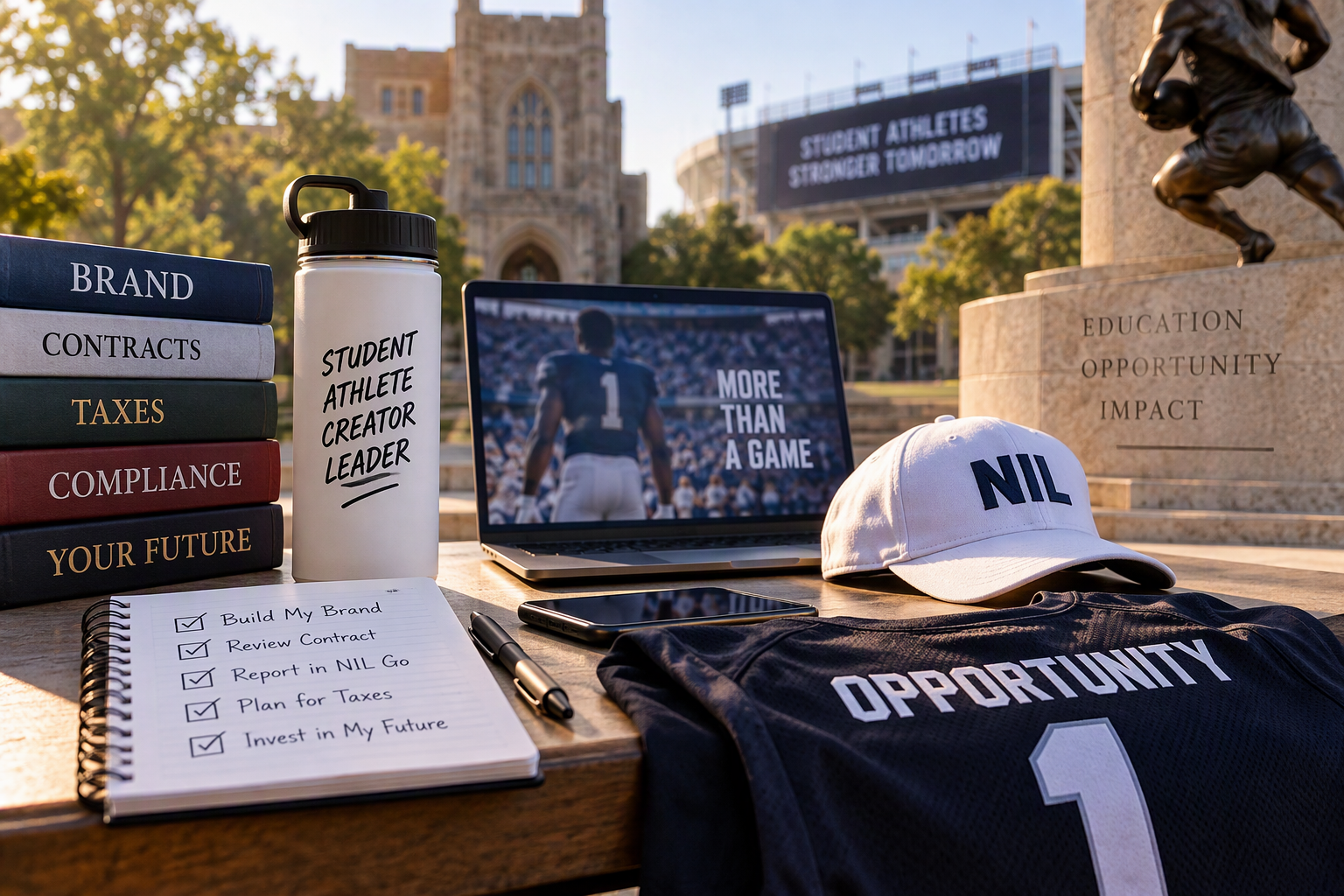
Name, Image, and Likeness (NIL) rules now let college athletes earn money from endorsements, appearances, content creation and licensing, while many Division I athletes can also receive revenue-sharing payments from their schools. This guide explains how NIL deals work, what remains restricted and how oversight operates after the House v. NCAA settlement.
College athletics has entered a new era.
For decades, NCAA athletes were generally prohibited from profiting from their athletic fame while enrolled in college. Today, that model looks very different. Athletes can earn income through Name, Image, and Likeness (NIL) agreements, and many Division I athletes can now also receive direct revenue-sharing payments from their schools under reforms implemented after the landmark House v. NCAA settlement.
The result is a complex system that combines scholarships, institutional compensation, and private-market endorsement opportunities. Understanding how NIL works requires separating legitimate commercial activity from common misconceptions about athletes simply being paid to play.
What Does NIL Mean?
NIL stands for Name, Image, and Likeness. The term refers to an athlete's right to profit from their personal brand and publicity rights.
Rather than being compensated for participating in a sport, athletes earn money by allowing businesses, organizations, or individuals to use their name, image, or likeness in commercial activities.
Examples of NIL opportunities include:
- Sponsored Instagram, TikTok, or YouTube content
- Product endorsements
- Commercial appearances
- Autograph signings
- Youth camps and clinics
- Merchandise licensing
- Local business promotions
- Brand ambassador partnerships
According to NCAA guidance, compensation can take several forms, including cash payments, products, services, or other valuable benefits provided in exchange for legitimate promotional activity.
How a Typical NIL Deal Works
Although every arrangement is different, most NIL agreements follow a similar process.
1. The Athlete Builds a Marketable Brand
An athlete's value often comes from a combination of factors, including:
- Athletic performance
- Social media reach
- Community recognition
- Personal storytelling
- Visibility through school and conference exposure
Importantly, brands often look beyond follower counts. Audience engagement and authenticity may be just as important as overall popularity.
2. A Company Identifies a Marketing Opportunity
Potential sponsors range from national corporations to small local businesses.
Common NIL partners include:
- Apparel brands
- Restaurants
- Car dealerships
- Technology companies
- Sports camps
- Fitness businesses
- Consumer-product companies
The underlying goal is commercial promotion. Businesses enter agreements because they believe an athlete's visibility can help generate awareness, trust, or sales.
3. Both Parties Sign a Contract
Most NIL agreements specify:
- Required promotional activities
- Payment terms
- Contract duration
- Use of intellectual-property rights
- Exclusivity requirements
- Content and appearance obligations
Recent NCAA transparency initiatives have placed increased emphasis on disclosure and contract reporting.
4. The Athlete Completes the Work
Deliverables may include:
- Social-media posts
- Public appearances
- Advertising campaigns
- Camp instruction
- Promotional videos
- Product endorsements
Like any commercial agreement, payment is typically tied to fulfilling contractual obligations.
5. Compensation Is Paid
Compensation structures vary.
Athletes may receive:
- Upfront payments
- Payments after completion
- Installment schedules
- Royalties
- Commission-based compensation
Because NIL earnings are generally taxable under U.S. law, NCAA guidance advises athletes to maintain records of income and expenses.
What Is Allowed Under NIL Rules?
Current rules generally permit NIL agreements when they involve real commercial activity and a legitimate business purpose.
Examples that are generally allowed include:
- Compensation for actual promotional services
- Product endorsements
- Marketing appearances
- Social media advertising
- Licensing arrangements
- Use of agents or professional advisors to negotiate deals
A key principle is that compensation should be connected to the athlete's commercial value and promotional work.
What Remains Restricted?
While NIL has expanded athlete opportunities, not every payment arrangement qualifies.
Regulators continue to scrutinize agreements that resemble:
- Pure pay-for-play compensation
- Recruiting inducements
- Payments solely for choosing a school
- Deals lacking meaningful promotional obligations
- Compensation without a valid commercial purpose
This distinction remains central to NCAA and post-settlement oversight efforts.
A common public claim is that NIL means athletes are now simply paid to play sports. The evidence suggests that characterization is misleading. Oversight systems continue to differentiate between legitimate NIL activity and payments tied solely to athletic participation or recruitment.
The House v. NCAA Settlement Changed Everything
The largest recent shift in college athletics came with the approval of the House v. NCAA settlement on June 6, 2025.
The settlement introduced several major changes:
- Direct revenue sharing between Division I schools and athletes
- Compensation for certain current and former athletes
- New reporting and oversight systems
- Revenue-sharing caps for participating institutions
This marked a fundamental departure from previous rules, under which schools generally could not compensate athletes through this type of revenue-sharing model.
The Revenue-Sharing Cap
According to the College Sports Commission, participating Division I institutions may share up to approximately 22% of certain athletics revenue with athletes.
For the 2026-27 academic year, the estimated cap is roughly $21.3 million per institution.
Importantly, these payments are separate from many third-party NIL opportunities.
That means an athlete may now receive:
- Scholarship benefits
- School-funded revenue-sharing compensation
- Independent NIL income
Together, those revenue streams represent the most significant economic transformation in NCAA history.
How NIL Deals Are Monitored
As compensation opportunities expanded, oversight mechanisms expanded as well.
NIL Go Reporting
Current Division I requirements generally require athletes to report qualifying NIL agreements above designated thresholds through NIL Go, a compliance-review platform.
A widely cited reporting threshold is $600 or more in aggregate value for reportable third-party NIL arrangements.
The College Sports Commission
The College Sports Commission (CSC) was established as a central oversight body within the post-House framework.
The CSC reviews reported agreements to evaluate whether:
- A legitimate business purpose exists
- Compensation appears reasonable
- The arrangement complies with applicable rules
The goal is to distinguish authentic market-based NIL transactions from impermissible recruiting inducements or disguised pay-for-play arrangements.
Who Earns the Most NIL Income?
Although many NIL earnings remain private, public reporting consistently indicates that the largest deals tend to flow toward:
- Football quarterbacks
- Men's basketball stars
- Women's basketball stars
- Athletes with major social-media followings
- Athletes in nationally prominent programs
However, NIL opportunities are not limited to high-profile sports.
Athletes in Olympic sports and other less-publicized programs can earn income through local endorsements, camps, clinics, appearances, and social-media partnerships. NCAA guidance permits NIL activity across all sports.
Has NIL Ended Amateurism?
The answer depends on how the term is defined.
The evidence strongly supports the conclusion that NIL has allowed athletes to monetize their personal brands. It also supports the conclusion that schools can now directly share significant revenue with athletes under the House framework.
Whether these developments have "ended amateurism" is more subjective.
Traditional NCAA amateurism has unquestionably been weakened by NIL rights and revenue sharing. Yet eligibility standards, compliance reviews, reporting obligations, conference rules, and regulatory oversight still remain in place.
As a result, the legal and operational framework governing college sports continues to evolve rather than disappear entirely.
What Happens Next?
Several important questions remain unresolved.
Future litigation could affect implementation of the House settlement. Federal legislation could eventually replace the current patchwork of state-level NIL approaches. Regulators continue debating how to determine reasonable market value in NIL transactions, and Title IX implications of revenue sharing remain the subject of ongoing legal discussion.
Those uncertainties mean the current NIL system is not necessarily the final version of college-athlete compensation.
The Bottom Line
NIL has transformed college athletics from a model that largely restricted athlete earnings into one that allows athletes to monetize their fame through endorsements, licensing, appearances, content creation, and other commercial ventures.
The House settlement accelerated that shift by allowing Division I schools to share revenue directly with athletes while preserving opportunities for third-party NIL compensation.
The strongest evidence supports three conclusions: NIL agreements are legitimate commercial arrangements tied to publicity rights, schools may now share substantial revenue with athletes under the House framework, and oversight remains a defining feature of the system. The debate over the future of college sports is far from settled, but the economics of college athletics have already changed permanently.
Key Takeaways
- NIL allows college athletes to profit from their name, image, and likeness through commercial activities.
- Common NIL opportunities include endorsements, social media promotions, appearances, camps, and licensing agreements.
- NIL compensation differs from pure pay-for-play arrangements under current oversight standards.
- The House v. NCAA settlement was approved on June 6, 2025.
- Division I schools may now share revenue directly with athletes.
- The projected revenue-sharing cap for 2026-27 is approximately $21.3 million per institution.
- Athletes may receive scholarships, revenue-sharing payments, and third-party NIL income simultaneously.
- NIL agreements above reporting thresholds are generally reviewed through NIL Go and related compliance systems.
- Significant legal and regulatory questions remain unresolved.
Sources
- Name, Image and Likeness (Official Guidance) , NCAA
- The House Settlement , College Sports Commission
- Implementation of the House Settlement Q&A , NCAA / Defendant Conferences (2026-05-01)
- NIL Reporting and NIL Go Guidance , College Sports Commission
- Proposed Division I Rule Changes Involving Student-Athlete NIL Activities , NCAA
- Division I Council Approves NIL Disclosure and Transparency Rules , NCAA (2024-01-10)
- The NCAA House Settlement: One Year Later , Akerman LLP (2026-07-28)