
Garage and Entry Doors Top Renovation Payback Rankings, With Caveats
National rankings favor small exterior replacements, but the percentages are professional estimates of resale value, not tracked sale prices.
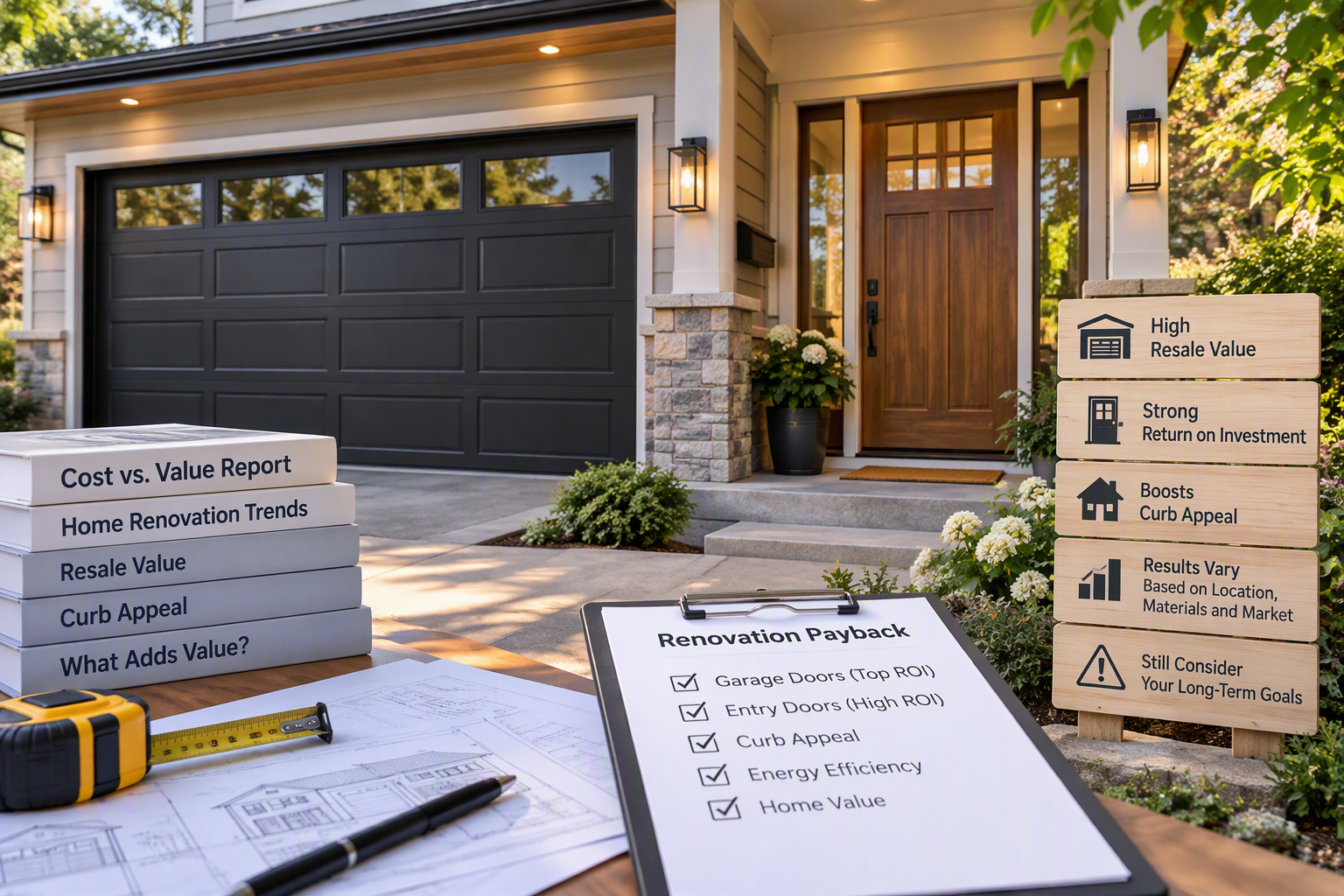
Zonda's 2025 Cost vs. Value report ranked garage door replacement first at 267.7% cost recouped, and NAR's 2025 report also put the steel entry door at the top. Both rankings rest on Realtor opinion and modeling rather than before-and-after sales, and the two reports disagree on size.
Small exterior replacements, led by garage doors and steel entry doors, top the most widely cited national ranking of renovation payback. In the 2025 edition of Zonda's Cost vs. Value report, the 38th, garage door replacement came first at 267.7% of its cost recouped. Each of the top three projects was estimated to add more than double its price at sale, according to Zonda's press release. The rankings matter because they steer a large amount of household spending, and because the headline percentages are easy to misread.
The figures are not measured gains from actual sales. In both major national reports, the value of a project is an estimate produced largely from the opinions of real estate professionals and from statistical modeling. This article draws on the 2025 Zonda report and the 2025 NAR/NARI Remodeling Impact Report, with earlier Zonda editions for trend. A 2026 Zonda edition could not be located in Jaroha's review, so the 2025 edition is the latest verified one. This is researched context, not personal financial advice.
What the two national rankings say
Zonda's Cost vs. Value report, 2025
Zonda's 2025 report covers 28 remodeling projects and compares the average cost of each with the value it retains at resale. According to Zonda, 8 of the top 10 projects are exterior replacements. Garage door replacement took first place for the second consecutive year, with a job cost of $4,672 and an estimated value at sale of $12,507.
A steel entry door replacement ranked second at 216.4%, and manufactured stone veneer ranked third at 207.9%. After those three, the numbers drop sharply. Fiber-cement siding recouped 113.7%, a minor kitchen remodel 112.9% and vinyl siding 96.5%. The minor kitchen remodel is the only interior project in Zonda's top five.
| Rank | Project | Job cost | Value at sale | Cost recouped |
|---|---|---|---|---|
| 1 | Garage door replacement | $4,672 | $12,507 | 267.7% |
| 2 | Steel entry door replacement | $2,435 | $5,270 | 216.4% |
| 3 | Manufactured stone veneer | $11,702 | $24,328 | 207.9% |
| 4 | Fiber-cement siding | $21,485 | $24,420 | 113.7% |
| 5 | Minor kitchen remodel | $28,458 | $32,141 | 112.9% |
| 6 | Vinyl siding | $17,950 | $17,313 | 96.5% |
Ranks 7 through 9 were not available in the sources reviewed. One further detail comes from Zonda's report: a backup generator entered the top 10 for the first time, with returns above 100% in hurricane-prone and storm-affected regions. Because that is a regional effect, a national average hides it.
The NAR/NARI Remodeling Impact Report, 2025
The second major national source is the Remodeling Impact Report from the National Association of Realtors (NAR) and the National Association of the Remodeling Industry (NARI). Its cost figures come from NARI contractors, according to trade coverage in Window & Door. Realtors estimate the dollar value each project would add at resale, and NAR then compares that figure with the contractors' cost estimate to arrive at a recovered project cost.
The top cost recovery in the 2025 NAR report belonged to a new steel front door at 100%, followed by closet renovation at 83% and a new fiberglass front door at 80%. Bathroom renovations lagged, recovering only 50% according to the figures reported by Qualified Remodeler and a Realtor association reprint of NAR's release.
How ROI is measured, and what it leaves out
The word 'return' suggests a measured outcome, but the reports work differently. In Zonda's 2024 methodology, the cost side starts from a baseline price for each project category, built from a price index that draws on Bureau of Labor Statistics consumer and producer price data and the Bureau of Economic Analysis personal consumption price index. Verisk's XactRemodel supplies local building-cost data. A 2021 trade article described a standard 10% markup on both materials and labor in the cost data, though whether that still applies in 2025 could not be confirmed.
The value side came from an online Zonda survey of more than 6,000 Realtors, conducted with NAR's Realtors Property Resource. Respondents saw project descriptions, photos, construction costs and the median home price in each city, then estimated what the work would add at sale. Beginning in 2022, Zonda added an econometric model that brings in variables such as local GDP, existing home sales and values, and housing starts. The stated reason was the difficulty of surveying enough real estate professionals in some areas.
Limits built into the method
Zonda itself describes the question as a narrow one, namely what a project adds to a home's sale price, and treats that as only one kind of value a home can provide. The metric therefore leaves out holding costs, financing, taxes, do-it-yourself labor, avoided maintenance, energy savings and day-to-day comfort. It also cannot capture whether deferred repairs, such as an aging roof, might block a sale.
A larger issue is the absence of validation. Jaroha's review found no published comparison of these estimates with matched before-and-after sale prices. Because the underlying data are opinion surveys, response bias is possible, and the response rate was not found. Realtors may also favor certain features, such as curb appeal. None of this means the estimates are wrong. It means they should be read as informed professional judgment rather than as outcomes observed in the market.
Why small exterior replacements beat big remodels
The pattern is stable across years, even though the percentages are not. In the 2022 edition, garage door replacement ranked first at 93%. Of the 22 projects that year, 11 were exterior replacements, and all of them ranked within the top 12, according to Woodworking Network. In 2021, Zonda reported a combined cost-to-value ratio of 60% across projects, well below the decade high of 71.2% in 2014. The best-performing interior project that year, a minor kitchen remodel, recouped 72%.
The 2024 edition showed the same order at higher levels. Garage door replacement recouped 194% ($4,513 cost, $8,751 value at sale), steel entry door 188% and stone veneer 153%. A minor kitchen remodel was at 96%, a mid-range bathroom at 74% and a composite deck at 68%, according to Zonda's 2024 press release. In the 2025 edition, fiber-cement siding rose from 88% to 113.7%, and vinyl siding from 80% to 96.5%. Not everything rose: the fiberglass grand entrance slipped from 97% to 84.7%.
Zonda's explanation
Zonda's commentary, republished by NARI, holds that the relatively few homes changing hands in today's market tend to be in solid condition, have well-appointed exteriors and sell at high prices. A Zonda principal for building products advisory added that housing demand shifted in 2025, much as it did in earlier adjustment periods such as 2012, and that remodel returns shifted with it. These are Zonda's interpretations. They are plausible, but the sources reviewed do not present tests of them.
A swing that deserves scrutiny
The garage door figure moved from 93% in 2022 to 194% in 2024 and 267.7% in 2025. A calculation by Jaroha from Zonda's published numbers, not a figure Zonda published, shows where the latest jump came from. Between 2024 and 2025, the garage door's job cost rose about 3.5%, from $4,513 to $4,672. Its estimated value at sale rose about 43%, from $8,751 to $12,507. Stone veneer followed a similar path, with estimated value up about 41%, from $17,291 to $24,328.
In other words, nearly all of the change comes from the value estimate rather than from what the work costs. Zonda attributes the shift to a changing market. A one-year jump of that size in a modeled estimate, with almost no change in cost, has not been independently validated, and it is reasonable to treat the exact percentages with caution while still trusting the broad ordering of projects.
Why the two reports disagree
The clearest example is the steel entry door. Zonda's 2025 table puts it at 216.4%, while the NAR/NARI report puts a new steel front door at 100%. The two measure different things in different ways: NAR pairs Realtor value estimates with cost estimates from NARI contractors, while Zonda uses its own cost model and survey-plus-econometric value estimates. The project specifications also differ, and a line-by-line comparison was not possible. A reasonable reading is that the two reports bracket a range rather than pinpoint a single truth.
What they share is more telling than where they differ. Both find that small, visible, exterior-facing replacements recover the most of their cost, and both find that bathrooms and larger interior remodels lag. Still, the agreement is not fully independent confirmation, since both rely on Realtors as the source of value estimates. NAR's 2025 report also changed structure, featuring only top projects for cost recovery and satisfaction instead of the earlier project-by-project layout, which makes year-over-year comparison difficult.
Kitchens and the problem of scope
Kitchens illustrate how much project scope matters. NAR gave a kitchen upgrade a perfect satisfaction score and found it was the most in-demand project, yet it does not appear among the report's top cost-recovery projects. Zonda's minor kitchen remodel, at a $28,458 job cost, recouped about 113% in 2025. A more extensive kitchen project is a different product, and the 2025 figures for upscale remodels were not retrieved.
Who publishes the numbers
None of the publishers is a neutral party on whether to renovate. Zonda is a building-industry data and media company, and no disclosures about funding or sponsor influence were found. NAR represents Realtors, who can benefit when sellers are encouraged to renovate, and NARI represents remodelers, who benefit from remodeling activity. That does not invalidate the findings, but it is a reason to read them as one input among several.
What homeowners get that resale math skips
NAR's report adds a measure that cost recovery cannot: the Joy Score, a 1-to-10 rating based on the happiness homeowners report after a project. Three projects earned a 10: a primary bedroom suite addition, a kitchen upgrade and new roofing. The typical Joy Score across projects was 8.2, and NAR reported that 43% of homeowners felt happy and 38% satisfied on seeing the finished work, according to NAR's press release.
The same survey points to motives beyond resale. Homeowners cited these main reasons for remodeling:
- Worn-out surfaces: 27%
- Energy efficiency: 19%
- Lifestyle change: 18%
- Preparing to sell: 18%
The report also found that 64% of respondents felt a stronger desire to be home after remodeling, and 92% said they would remodel more if cost were not a barrier. These are self-reported results from a single year of NAR's survey, so they suggest a pattern rather than settle it.
Where enjoyment and resale advice diverge
Realtors' advice for sellers looks different from homeowners' own favorites. The projects Realtors most often recommended before a sale were painting the entire home (50%), painting one room (41%) and new roofing (37%). The most in-demand projects among homeowners were a kitchen upgrade (48%), new roofing (43%) and a bathroom renovation (35%). NAR's Jessica Lautz spoke to this gap, noting that homeowners enjoy seeing their own tastes realized while Realtors may recommend different strategies to enhance resale value, according to NARI's coverage of the report.
Local markets, timing and a home's condition
National averages smooth over a lot of variation. Local markets, a home's age and condition, its price tier and the specific product chosen all change the result. Zonda's own backup generator finding is a case in point, with returns above 100% in storm-prone regions that do not show up in a national figure. A commercial site's claim that garage door replacement ranked first in all nine regions could not be corroborated and should be treated as unverified.
Timing matters in a different way. Harvard's Joint Center for Housing Studies (JCHS) tracks remodeling spending on owner-occupied homes through its Leading Indicator of Remodeling Activity. JCHS reported spending of $514 billion in the fourth quarter of 2025, up 2.7% from a year earlier. A later edition put first-quarter 2026 spending at $521 billion, up 2.0% from the first quarter of 2025, with growth projected to slow to 0.5% by the first quarter of 2027, to about $523 billion, according to trade reprints of the JCHS releases. These figures describe activity, not payback, and they cannot say which projects pay off.
Totals also depend on definitions. NAR estimated that Americans spent about $603 billion on home remodeling in 2024, a figure that differs from Harvard's series because the two define the market differently. Many commercial websites labeled 2026 also publish garage door and entry door returns that conflict with Zonda's published 2025 table. Those pages are sellers, search-driven guides or unattributed, and none of their figures were used here.
What to watch next
The durable finding is about direction, not decimals. Replacing a worn front door or garage door costs little relative to a kitchen or bathroom gut job, and professionals consistently estimate that buyers value a well-kept exterior. The exact percentages are estimates that shifted sharply in a single year, and homeowners who plan to stay put are weighing things the resale math was never built to count.
The next test is whether a newer Zonda edition holds the 2025 levels or pulls them back, and whether anyone compares these estimates with actual before-and-after sales. Until then, the rankings are best read as a guide to relative payback, with local conditions and a home's own needs deciding the rest.
Frequently asked questions
Which home renovation has the highest ROI?
In Zonda's 2025 Cost vs. Value report, garage door replacement ranked first at 267.7% of cost recouped, ahead of steel entry door replacement at 216.4% and manufactured stone veneer at 207.9%. In NAR's 2025 report, a new steel front door led at 100% cost recovery. Both are estimates of value added at sale rather than measured sale-price gains.
Is 268% cost recouped the same as a 268% return on investment?
No. Zonda's cost recouped is the estimated value added divided by the job cost. The usual ROI definition is net gain divided by cost, so 268% recouped would be roughly a 168% return. Several commercial sites blur the two terms.
Does a kitchen or bathroom remodel pay for itself at resale?
Mostly not in these reports. Zonda's minor kitchen remodel recouped about 112.9% in 2025, but NAR's report put bathroom renovations at 50% cost recovery. Zonda's 2024 report had a mid-range bathroom at 74%, and the 2025 figure was not verified.
Why do Zonda and NAR give different numbers for the same project?
They pair different cost estimates with different groups of Realtor value estimates, and their project specifications are not identical. Zonda also uses an econometric model. The steel entry door, for example, is 216.4% in Zonda's table and 100% in NAR's report.
Do the rankings apply to every local market?
Not necessarily. The figures are national averages, and local markets, home condition and price tier all change results. Zonda notes, for example, that backup generators returned more than 100% in hurricane-prone and storm-affected regions.
Sources
- 2025 Cost vs. Value Report , Zonda
- ZONDA'S 38th ANNUAL COST VS. VALUE REPORT CONFIRMS EXTERIOR PROJECTS CONTINUE TO DELIVER THE HIGHEST ROI , Yahoo Finance (Zonda press release)
- Exterior Upgrades With High ROI , NARI (2025-12-01)
- Zonda's 2024 Cost vs. Value Report Proves 'Curb Appeal' Still Drives Highest Value For Home Improvement Projects , PRWeb (2024-04-23)
- Methodology - Journal of Light Construction , Journal of Light Construction
- Cost vs. Value: Key Trends in the 2022 Cost vs. Value Report , Remodeling
- Key Trends in the 2021 Cost vs. Value Report , Journal of Light Construction
- 2021 Cost vs. Value Report by Zonda Reveals 22 of the Most Lucrative Remodeling Projects Across the Nation , PRWeb
- Cost vs. value report reveals best remodeling ROI projects , Woodworking Network
- Top Remodeling Projects for Homeowner Satisfaction and Cost Recovery Revealed in NAR Report , National Association of Realtors
- National Association of Realtors Releases Remodeling Impact Report , Window & Door
- Remodeling Impact Report: Top Projects, Cost Recovery, and Owner Satisfaction , Qualified Remodeler
- Remodeling Impact Report: Top Projects, Cost Recovery, and Owner Satisfaction , NARI (2025-04-09)
- Top Remodeling Projects for Homeowner Satisfaction and Cost Recovery Revealed in NAR Report , Pennsylvania Realtor association (pfar.org)
- Continued Gains Projected for Remodeling Amid Economic Uncertainty , Harvard Joint Center for Housing Studies
- Remodeling growth set to downshift in late 2026 , LBM Journal (Harvard JCHS press release) (2026-01-28)
- Harvard LIRA Predicts Remodeling Softening through 2026 , Composite Panel Association
- Harvard LIRA Predicts Remodeling Softening , Composite Panel Association
This article was drafted with the help of AI and reviewed by Jaroha editors before publication.