
Anti-Inflammatory Foods: Diet Patterns Beat 'Superfoods' in the Evidence
Trials point to Mediterranean-style eating as the best-supported approach, while evidence for single foods and supplements is smaller and less consistent.
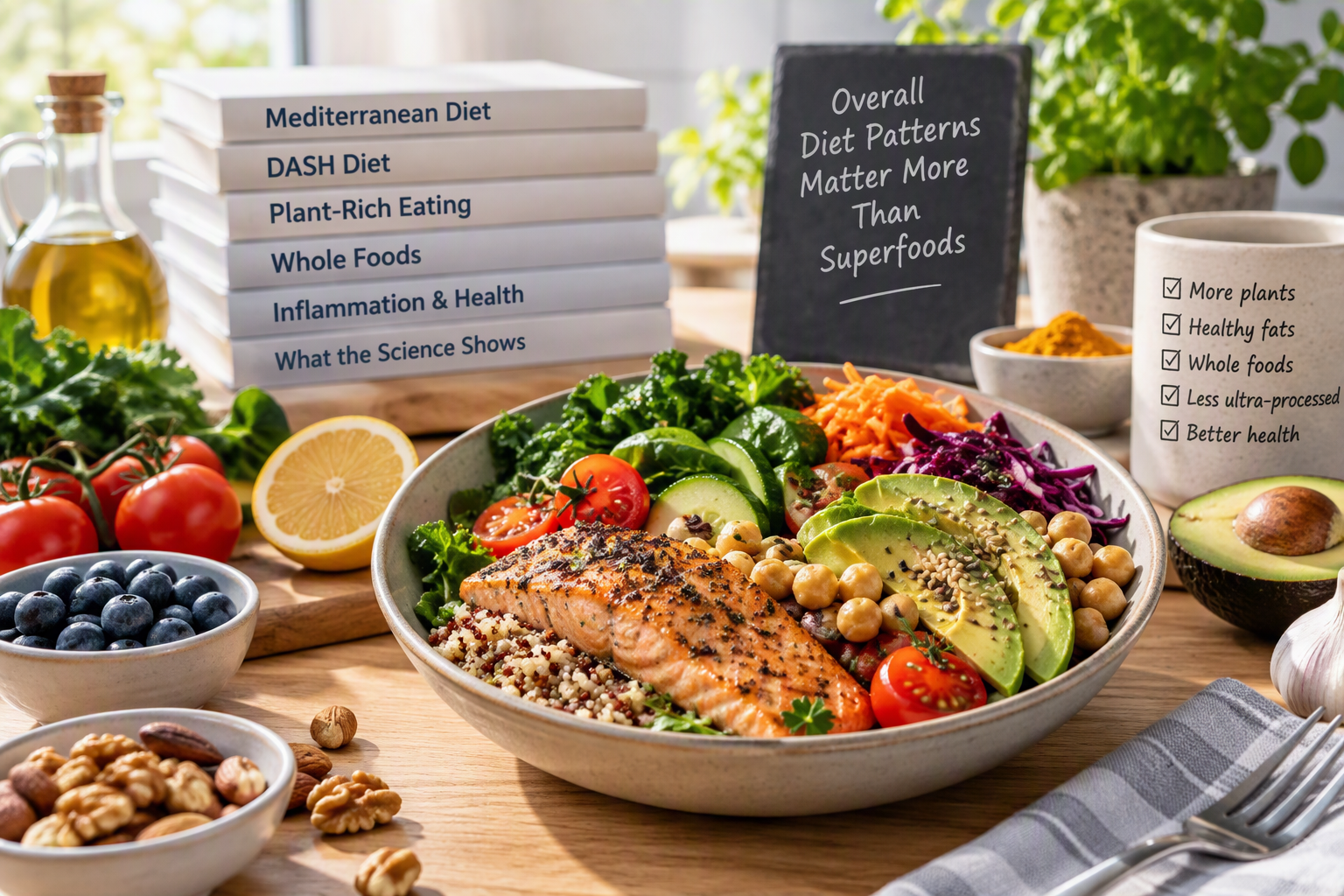
Randomized trials suggest a Mediterranean-style diet modestly lowers some blood markers of chronic inflammation. Evidence for individual foods such as nuts and whole grains is weak or small, and omega-3 and curcumin results come from supplements, not food. Whether these shifts improve health outcomes is still unresolved.
The foods with the strongest scientific case for calming chronic inflammation are not individual 'superfoods' but whole dietary patterns, most clearly the Mediterranean diet. Meta-analyses of randomized trials find it modestly lowers some blood markers of low-grade inflammation. Evidence for single foods such as nuts and whole grains is thinner, and the best-known anti-inflammatory results for omega-3 and curcumin come from supplements.
The distinction matters because the word 'anti-inflammatory' implies that a food acts like a drug. The research is more modest. Most trials measure blood markers, not disease, so a lower reading is not the same as fewer heart attacks or less arthritis.
What the studies actually measure
Nearly all of the evidence below tracks CRP, IL-6, TNF-α and related markers in adult volunteers. A second tool, the Dietary Inflammatory Index (DII), scores a whole diet by its estimated inflammatory potential, based on how dietary components are associated with circulating inflammatory markers.
Research comes mostly from Europe, the United States and Iran. The evidence reviewed here runs from older meta-analyses to work published in 2025 and 2026. Pooled results often use standardized effect sizes, which are hard to translate into milligrams per liter of CRP, so what a given change means for an individual remains unclear.
The Mediterranean pattern has the best support
A 33-trial review finds selective effects
A systematic review and meta-analysis in Nutrition Reviews pooled 33 randomized controlled trials with 3,476 participants, searching PubMed, Web of Science and Scopus up to July 2024. The Mediterranean diet significantly reduced hs-CRP, IL-6 and IL-17 compared with control diets.
The picture was not uniform. The same review found no significant effect on CRP, IL-10, TNF-α or total antioxidant capacity, and its authors said further high-quality studies are needed to confirm the findings. A pattern that moves some markers and not others is a modest result, not a sweeping one.
Olive oil: a promising but fragile estimate
Another meta-analysis examined Mediterranean diets enriched with olive oil, using data from 9 interventions. CRP/hs-CRP and IL-6 improved, while TNFα, MCP-1 and IFN-γ did not change notably.
The IL-6 estimate was a standardized mean difference of −1.85 (95% confidence interval −3.69 to −0.01), with heterogeneity (I²) of 99.29%. The interval nearly touches zero and the trials differ enormously, so the figure is an average across very different studies rather than a precise effect.
Earlier PREDIMED work points the same way. A commentary summarizing a pilot of the trial reported that two Mediterranean diets over 3 months reduced hs-CRP, IL-6 and adhesion molecules versus a low-fat diet. Because that source is secondary, the original paper would be the better basis for firm conclusions.
Single foods: small effects and null results
Whole grains
A meta-analysis of 9 randomized trials with 838 participants found an inverse association between whole grain intake and inflammatory markers, with a standardized mean difference of 0.16 (95% CI 0.02–0.30). The effect is small and the interval nearly reaches zero. Its searches covered studies published before January 1, 2018.
Nuts
Nuts are a staple of the Mediterranean pattern, yet trials of nuts alone are largely unimpressive. A 2018 meta-analysis in Nutrition of 23 trials with 1,221 adults found that nuts significantly reduced ICAM-1 but had no significant effect on CRP, VCAM-1, IL-6, TNF-α or E-selectin.
A separate meta-analysis of 32 trials found non-significant changes in other biomarkers, indicating a lack of consistent evidence for effects of nuts on inflammation. It did find a favorable effect on flow-mediated dilation, a measure of endothelial function. A 2022 walnut meta-analysis found no significant influence on CRP (SMD −0.37; 95% CI −1.39 to 0.65), though some other markers did change.
Overall it would appear that nuts have very little effects on inflammatory markers.
A preprint reports that six weeks of daily almonds improved inflammatory cytokine profiles in adults with obesity without weight change. It is a parallel-arm randomized trial that has not been peer reviewed, so it cannot yet carry much weight. One reading of the broader pattern is that the whole diet, or the olive oil, matters more than nuts alone, but that is an inference, not a tested finding.
Omega-3 and curcumin: supplement results, not food results
Two of the best-known anti-inflammatory claims rest on capsules and extracts. An umbrella meta-analysis pooled 148, 86 and 73 trials for CRP, IL-6 and TNF-α, and found that omega-3 supplementation significantly reduced CRP (effect size −0.40; 95% CI −0.56 to −0.24), with I² of 89.5%.
A 2025 dose-response meta-analysis of 40 trials found significant non-linear CRP reductions in people with cardiovascular disease, metabolic syndrome and hypertension, up to 1,200 mg/day of EPA+DHA. It found no significant CRP reduction in overweight and obese participants. The evidence therefore concerns people with cardiometabolic conditions, not healthy adults.
For curcumin, a 2021 meta-analysis found CRP fell significantly versus placebo (weighted mean difference −3.67 mg/L; 95% CI −6.96 to −0.38), drawing on 9 CRP studies and 23 hs-CRP studies. An umbrella meta-analysis reported a CRP reduction with an effect size of −0.74 (95% CI −1.11 to −0.37; I² 62.1%).
Reviews of the curcumin literature disagree on how consistent it is. A review of meta-analyses found CRP fell in seven of ten meta-analyses, while another review said findings are inconsistent. Doses in extracts also sit far from typical culinary or dietary intake, so these results do not automatically transfer to eating fish or cooking with turmeric.
| Intervention | Evidence base | Outcome | Pooled result | Heterogeneity (I²) |
|---|---|---|---|---|
| Mediterranean diet | 33 RCTs, 3,476 people | hs-CRP, IL-6, IL-17 | Significant reductions | Not reported here |
| Mediterranean diet | 33 RCTs, 3,476 people | CRP, TNF-α, IL-10 | No significant effect | Not reported here |
| Mediterranean diet + olive oil | 9 interventions | IL-6 | SMD −1.85 (−3.69 to −0.01) | 99.3% |
| Whole grains | 9 RCTs, 838 people | Inflammatory markers | SMD 0.16 (0.02–0.30) | Not reported here |
| Nuts | 23 RCTs, 1,221 adults | ICAM-1 reduced; CRP, IL-6, TNF-α not significant | Not reported here | Not reported here |
| Walnuts | RCT meta-analysis, 2022 | CRP | SMD −0.37 (−1.39 to 0.65), not significant | Not reported here |
| Omega-3 supplements | Umbrella, 148 trials for CRP | CRP | ES −0.40 (−0.56 to −0.24) | 89.5% |
| Curcumin supplements | 9 CRP and 23 hs-CRP RCTs | CRP | WMD −3.67 mg/L (−6.96 to −0.38) | Not reported here |
What is linked to more inflammation, and whether it matters
Ultra-processed foods (UPF) are the most studied dietary signal on the other side. A 2025 analysis of NHANES data in the American Journal of Medicine, covering a nationally representative sample of 9,254 people, compared the share of calories from UPF. Against a reference group getting 0–19% of calories from UPF, those at 40–59% had a risk ratio for higher hs-CRP of 1.14 (95% CI 1.03–1.27), and those at 60–79% had 1.11 (1.01–1.21). The 20–39% group showed a non-significant 7% increase.
The pattern is not strictly dose-responsive, since the ratio was higher at 40–59% than at 60–79%, and the analysis captured a single time point. A 2025 scoping review found that among adults, 11 of 17 analyses reported higher CRP or hs-CRP with greater UPF intake, 5 of 17 found no association, and 1 found an association only in women.
A UC Davis nutrition researcher, quoted in a UPI report, cautioned that most existing studies linking ultra-processed foods to health outcomes are observational. Confounding by overall diet quality, body weight, smoking and income is likely, so these findings show association, not cause.
Diet scores tell a similar story at a larger scale. A 2021 umbrella review00463-X/fulltext) of 15 meta-analyses covering 38 outcomes and more than 4.36 million participants found that a pro-inflammatory dietary pattern was associated with higher risk for 27 (71%) of the outcomes. Most outcomes, however, had Class III (suggestive) or weaker evidence. A newer umbrella review of 90 systematic reviews and/or meta-analyses reached a similar conclusion and stated that future randomized trials are warranted to confirm the benefits of anti-inflammatory diet patterns.
What it means and what to watch
The most defensible reading is modest. A Mediterranean-style pattern of olive oil, vegetables, fish, whole grains, nuts and limited processed foods has several agreeing meta-analyses behind it, though effects are small, heterogeneity is high and some markers do not move. Single foods fare worse, and supplement results cannot be assumed to apply to the foods they come from.
The open question is the one that matters most: whether lowering these markers through diet improves health. Settling it would take large, long randomized trials of dietary patterns that track disease outcomes and treat inflammation as a possible mediator. Until then, 'anti-inflammatory' is best read as a description of a biomarker trend, not a promise of protection.
Frequently asked questions
What is the best anti-inflammatory diet according to research?
The Mediterranean diet has the strongest trial support. A meta-analysis of 33 randomized trials found it significantly reduced hs-CRP, IL-6 and IL-17, though not CRP, IL-10 or TNF-α. Confidence in the finding is moderate because effects are small and the authors called for more high-quality studies.
Do nuts reduce inflammation?
Mostly not by the markers measured in trials. A meta-analysis of 23 trials found no significant effect on CRP, IL-6 or TNF-α, though ICAM-1 fell. A review of meta-analyses concluded that nuts have very little effect on inflammatory markers.
Are fish oil and turmeric supplements the same as eating fish or using turmeric?
The evidence does not show that. The trials tested capsules and extracts, and doses differ widely from typical dietary intake. Omega-3 effects on CRP were found in people with cardiometabolic disease, not in overweight or obese participants.
Do ultra-processed foods cause inflammation?
They are associated with higher CRP in most observational analyses, but causation is not established. In a 2025 scoping review, 11 of 17 adult analyses found higher CRP with greater intake and 5 of 17 found no association. Confounding by overall diet quality, weight, smoking and income is likely.
Does lowering CRP through diet prevent disease?
That remains unresolved. The trials measure blood markers, not disease, and the reviews retrieved call for randomized trials to confirm benefits. Evidence linking inflammatory diet scores to disease is observational, and most outcomes were graded suggestive or weaker.
Sources
- Mediterranean Diet Reduces Inflammation in Adults: A Systematic Review and Meta-analysis of Randomized Controlled Trials , Nutrition Reviews / PubMed
- The effects of the mediterranean diet supplemented with olive oils on pro-inflammatory biomarkers and soluble adhesion molecules: a systematic review and meta-analysis of randomized controlled trials , PMC
- A Traditional Mediterranean Diet Effectively Reduces Inflammation and Improves Cardiovascular Health , PMC
- Whole grain diet reduces systemic inflammation: A meta-analysis of 9 randomized trials , PMC
- Effects of nut consumption on selected inflammatory markers: a systematic review and meta-analysis of randomized controlled trials , Nutrition / ScienceDirect
- The effect of nut consumption on markers of inflammation and endothelial function: a systematic review and meta-analysis of randomised controlled trials , PubMed
- Nuts and Cardio-Metabolic Disease: A Review of Meta-Analyses , PMC
- Walnut Intake Interventions Targeting Biomarkers of Metabolic Syndrome and Inflammation in Middle-Aged and Older Adults: A Systematic Review and Meta-Analysis of Randomized Controlled Trials , Antioxidants / PMC (2022-07-21)
- Almond Consumption Improves Inflammatory Profiles Independent of Weight Change: A 6-Week Randomized Controlled Trial in Adults with Obesity , medRxiv (preprint, not peer reviewed)
- Efficacy of the omega-3 fatty acids supplementation on inflammatory biomarkers: An umbrella meta-analysis , ScienceDirect
- Dose-dependent effects of omega-3 polyunsaturated fatty acids on C-reactive protein concentrations in cardiometabolic disorders: a dose-response meta-analysis of randomized clinical trials , PubMed
- Effect of curcumin on C-reactive protein as a biomarker of systemic inflammation: An updated meta-analysis of randomized controlled trials , Phytotherapy Research / PubMed
- Profiling Inflammatory Biomarkers following Curcumin Supplementation: An Umbrella Meta-Analysis of Randomized Clinical Trials , PMC
- Is Curcumin Intake Really Effective for Chronic Inflammatory Metabolic Disease? A Review of Meta-Analyses of Randomized Controlled Trials , Nutrients / PMC
- Ultra-processed foods and increased high sensitivity C-reactive protein , American Journal of Medicine / PubMed (2025-12-01)
- Ultra-Processed Food Consumption and Systemic Inflammatory Biomarkers: A Scoping Review , Nutrients / PMC (2025-09-20)
- Big consumers of ultra-processed foods show most inflammation: study , UPI (2025-10-02)
- The Dietary Inflammatory Index and Human Health: An Umbrella Review of Meta-Analyses of Observational Studies , Advances in Nutrition
- The association of dietary inflammation index (DII) and health-related outcomes: An umbrella review of systematic reviews , PubMed
This article was drafted with the help of AI and reviewed by Jaroha editors before publication.